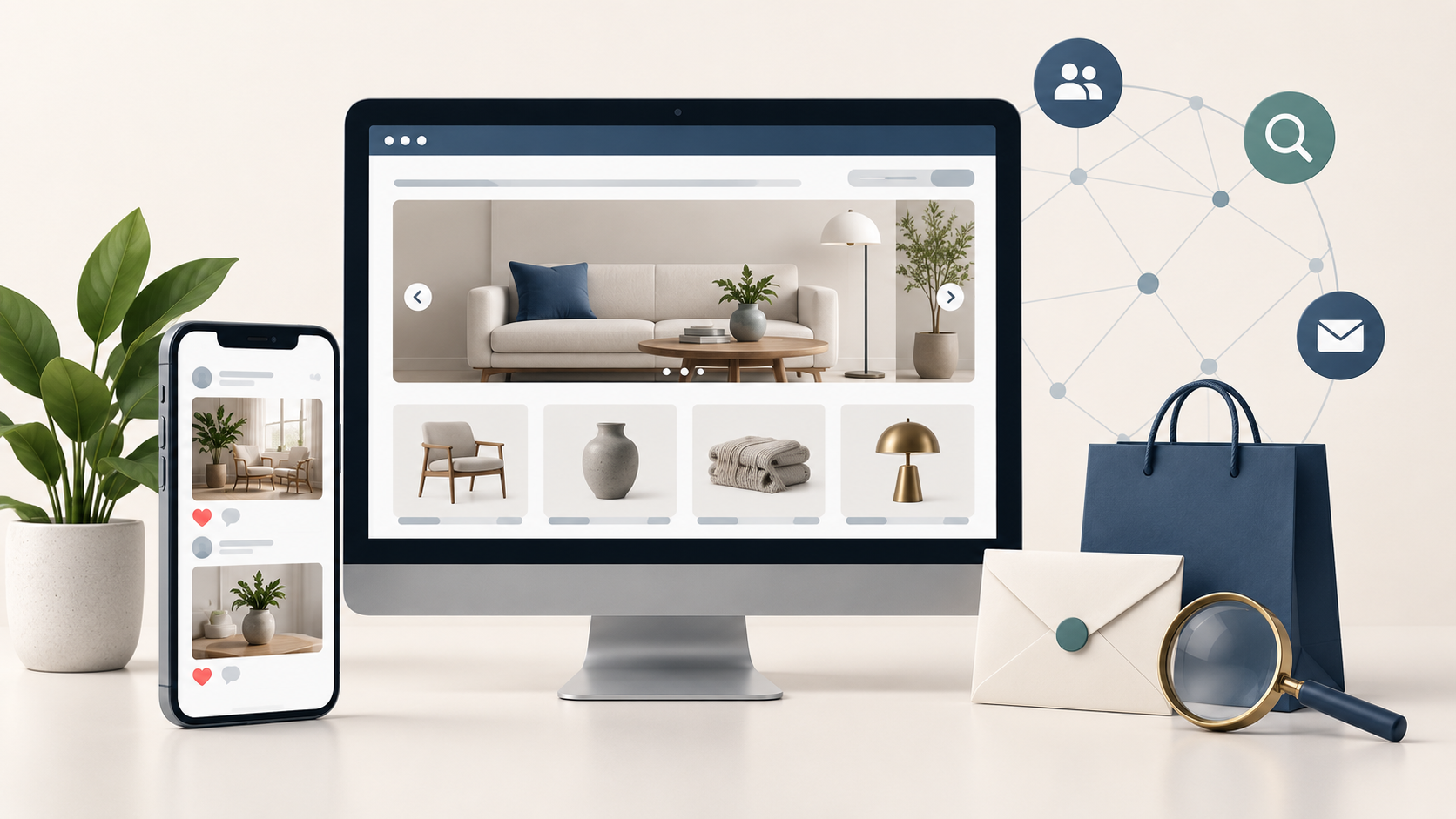
Social media is useful for a business. It can help people discover you, see your work, ask questions, and share your name with friends. For many small businesses, it is the first place they show up online.
But social media should not be the only place your business lives. A social profile is a space you use under someone else’s rules. The platform controls what people see, how often they see it, and whether your account remains available. Your own website gives customers a steady place to check the facts and take the next step.
This does not mean you need to abandon Instagram, Facebook, TikTok, LinkedIn, or any other platform. Social media is often excellent for attention and conversation. The better plan is to use it as a way to bring people toward a home base that your business controls.
A website does more than display your logo
A good website answers the questions a customer has before they call or buy. What do you offer? Who do you help? Where do you work? What does it cost, or how can someone request a quote? What happens next? Why should someone trust you?
A social profile can answer some of these questions, but important details are often spread across a short biography, old posts, pinned content, comments, and direct messages. A customer may have to search through your profile to learn whether you still offer a service or work in their area.
Your own website lets you put the important answers in one clear place. It can also give people several ways to move forward. Someone may not be ready to buy today, but they may be ready to call, request information, join an email list, save your number, or return later. That gives the business a better chance to stay connected without paying to reach the same person again.
Online store studies also show why averages need to be treated carefully. Different products, prices, devices, and customers produce very different results. Littledata’s study of 2,800 Shopify stores found an average purchase rate of 1.4%, while Shopify’s newer guide shows that published averages vary widely by industry. These numbers are not promises. They are a reminder that a business should measure its own results instead of assuming that a social post or a website will perform the same for everyone.
People check before they trust
A social post can make someone curious. A website often helps them decide. This matters more when the purchase is expensive, personal, or difficult to reverse.
Someone buying a small item may be comfortable checking out inside a social app. Someone hiring a contractor, choosing a professional service, placing a large order, or starting a long-term relationship usually wants more information. They may look for examples of the work, service details, location, hours, policies, reviews, and a real way to contact the business.
A 2024 survey of business buyers found that web search was one of the first resources many buyers used, and vendor websites were also among the first places they checked. Social media still played a role, especially for professional recommendations and industry conversations. The lesson is not that social media has stopped mattering. It is that a business can be missed when it has no clear public place for a serious buyer to review.
For a local business, the website does not need to be large. A clear homepage, services page, about page, contact page, and a few useful examples may be enough to make the business easier to understand. The important thing is that the information is current and easy to find.
Search is changing, but clear websites still matter
People now ask search tools longer questions. Some also ask AI assistants for recommendations, comparisons, and explanations. These tools can only consider information they can reach, read, and understand.
Google says its AI search features use the same basic website foundations as regular search. There is no magic switch and no guaranteed way to appear in an AI answer. A page still needs to be public, readable, connected to the rest of the website, and useful to the person asking the question.
That is good news for small businesses. You do not need to write for a machine or fill your pages with strange phrases. You need to explain your business plainly. Say what you do, who it is for, where you work, what questions you answer, and how someone can reach you. A clear page can help a customer today and give search tools better information to work with later.
Your reach can change overnight
The other problem with using one social platform as your whole business is that the platform can change the deal without asking you. An algorithm can show fewer of your posts. A rule change can limit your account. A technical mistake can make your profile disappear while an appeal is being reviewed.
Hootsuite summarizes one widely reported change: Facebook’s average unpaid reach fell from about 16% in 2012 to roughly 1%–2% in 2025. The exact number varies by page and post, but the direction is clear. Having followers does not guarantee that followers will see your next announcement.
One Canadian fashion retailer experienced the risk directly. Retail Insider reported that Mine & Yours attributed about 60% of its sales to Instagram when the account was suspended. The business had about 60,000 followers, and the owner estimated that the disruption cost more than $100,000 over the following months. The account was eventually part of the recovery effort, but the lost time and sales could not simply be restored by having a large audience.
The practical lesson is not to panic or stop posting. It is to avoid putting every customer relationship in one company’s hands. Keep an up-to-date website. Save customer contact details when people give permission. Make sure customers know how to reach you outside one social app. Keep copies of important photos, offers, and business information.
A simple plan for a stronger foundation
If your business mostly operates through social media, start small:
- Build one clear website page that says what you do, who you serve, where you work, and how to contact you.
- Add the questions customers ask most often, with direct answers.
- Link to the website from every social profile and important campaign.
- Make sure your phone number, email address, hours, location, and service list are current.
- Give interested customers a clear way to stay in touch, with their permission.
- Review the site every few months and update anything that has changed.
Social media can remain the front door that introduces people to your business. Your website should be the dependable place they can visit after that introduction. The goal is not to choose between social media and a website. The goal is to use social media for reach while building an online foundation that your business can keep, explain, and grow.