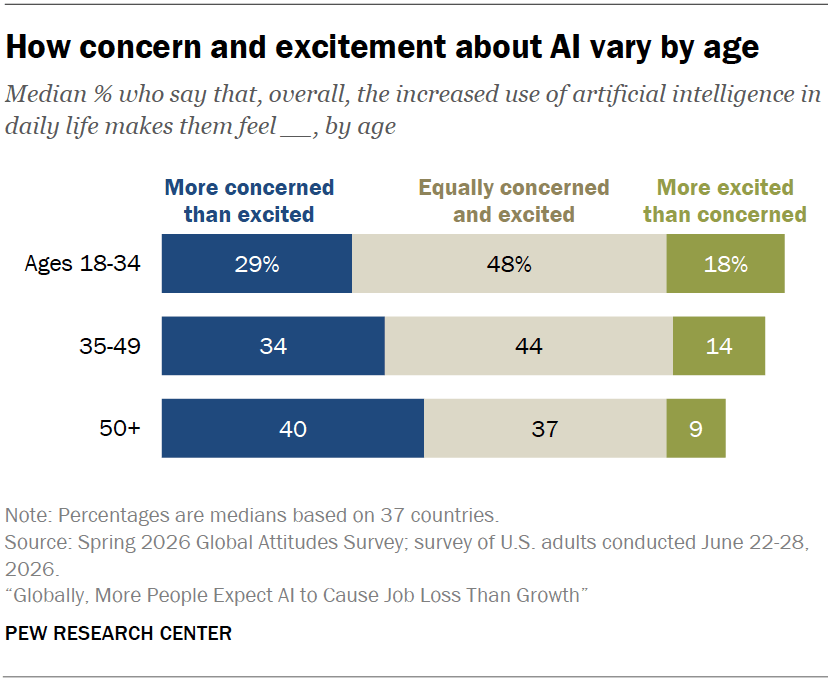
A chart from Pew Research Center shows that people are not forming a simple pro-AI or anti-AI camp. Many people feel two things at once: they can see why artificial intelligence may be useful, but they are also worried about what it could change.
That mixed feeling is especially clear among adults ages 18 to 34. Across the countries shown in the chart, a median of 29% say they are more concerned than excited about the increased use of AI in daily life. Another 48% say they are equally concerned and excited, while 18% say they are more excited than concerned. The largest group is not cheering or rejecting the idea. They are holding both feelings at the same time.
The older groups lean more toward concern. Among adults ages 35 to 49, 34% are more concerned than excited, compared with 44% who feel both equally. Among adults ages 50 and older, 40% are more concerned than excited, while 37% feel both equally and 9% are more excited than concerned. The chart uses median percentages based on 37 countries. The three displayed groups do not add up to 100%, so the remaining answers are not shown.
Younger people are not automatically sold on AI
It is easy to assume that younger adults welcome every new technology and older adults resist it. This chart does not support that simple story. Younger adults are more likely to feel both concerned and excited, but a sizeable group is still more concerned than excited. The wider Pew study also found that young adults in some countries are particularly worried about how AI could affect jobs.
That makes sense in everyday life. Younger workers may expect to live with these changes for a longer part of their careers. They may see new ways to learn, create, and save time. They may also wonder whether the skills they are building today will still be valued tomorrow. Interest and worry can grow together.
Older adults may have a different reason to be cautious. They may have seen many promised changes arrive slowly, work unevenly, or create new problems. They may want to know who is responsible when a computer-made answer is wrong. They may also be less interested in a new tool unless it clearly helps with something they already need to do.
These are not rules for every person. They are reminders that a business should not talk about AI as if everyone sees it the same way.
Trust has to come before speed
For a business, the lesson is simple: do not lead with the tool. Lead with the problem it is meant to solve.
If a new system helps answer common questions, explain which questions it can handle and when a person will step in. If it helps sort incoming requests, tell customers that someone still checks the important details. If it helps prepare a first draft, make it clear that a person reviews the final message before it goes out.
People do not need a grand promise. They need to know what will happen when they contact you. They want to know whether they can reach a real person, whether their information will be treated carefully, and what to do if the answer they receive does not look right. Clear answers to those questions can make a new tool feel less like a replacement and more like a helpful assistant.
Start with work people already dislike
The safest place to begin is often a small, repeated task that nobody wants to spend their best time doing. That might be organizing a long list of questions, finding information in a set of documents, or preparing a first version of a routine message. These tasks can be checked by a person before they affect a customer.
A business can then ask ordinary questions. Did the team save time? Were fewer details missed? Did customers receive clearer answers? Did employees feel supported, or did the new process create more confusion? If the change does not improve the work, there is no prize for keeping it just because it uses AI.
The age differences in this chart are not a reason to market one message to young people and another to older people. They are a reason to communicate with more care. Show the useful part. Name the limit. Keep a person responsible for important decisions. Give customers a clear way to ask for help.
AI may become a normal part of daily life, but normal does not mean automatically trusted. The businesses that handle this well will be the ones that understand both sides of the public mood: people are curious about what these tools can do, and they want proof that the human parts of work and service will not be pushed aside.